
I’m in the middle of deciding whether this is a good thing or something to be avoided.
Probably one of the more difficult questions of our witness we face today.
If you have thoughts let me know either via email or comment.
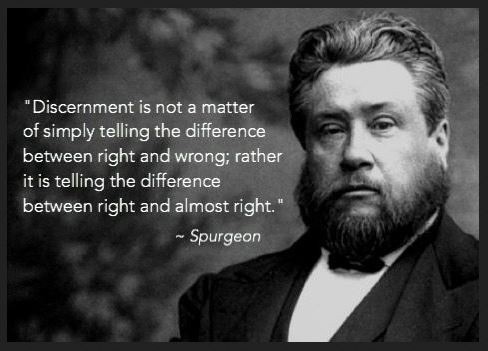
That’s similar to this statement:
Even Johanthan Edwards, credited with ‘starting’ the Great Revival of the 1700s, viewed the emotional excesses accompanying the Revival with guardedness and suspicion. He urged caution. In Edwards’ biography of David Brainerd, Edwards assessed the Great Awakening’s failure, “An intemperate imprudent zeal, and a degree of [fleshly] enthusiasm soon crept in, and mingled itself with that revival of religion; … neither people nor ministers had learned thoroughly to distinguish between solid religion and its delusive counterfeits;”
After the article I will add a few scripture passages. The largest one is Paul addressing(debating) those in Corinth. Not quite the same, but an example of Paul is addressing those of various false religion views. We clearly have a call to do that. Some will hear. But even in Jesus’ own teaching many found it hard and walked away.
The real issue is joining with those preaching other “truths”, risking having the actual gospel message diluted or as one of my old friends says making all religions just the same…just different packaging. Elizabeth Prata does list a number of the many false teaching passages in the Bible. These are obvious…and need to be observed.
If one does go this direction, then the clear and complete teaching of the gospel needs to be made. And although John 6:66 is maybe the saddest verse in the Bible…. It’s a reality we need to accept, God is Sovereign.
John 6:64-66 KJV But there are some of you that believe not. For Jesus knew from the beginning who they were that believed not, and who should betray him. 65 And he said, Therefore said I unto you, that no man can come unto me, except it were given unto him of my Father.
66 From that time many of his disciples went back, and walked no more with him.
Acts 17:22-34 1599 Geneva Bible
22 [a]Then Paul stood in the midst of Mars’ street, and said, Ye men of Athens, I perceive that in all things ye are too [b]superstitious.
23 For as I passed by, and beheld your [c]devotions, I found an altar wherein was written, UNTO THE [d]UNKNOWN GOD. Whom ye then ignorantly worship, him show I unto you.
24 [e]God that made the world, and all things that are therein, seeing that he is Lord of heaven and earth, dwelleth not in temples made with hands.
25 Neither is worshipped with men’s hands, as though he needed anything, seeing he giveth to all life and breath and all things,
26 [f]And hath made of [g]one blood all mankind, to dwell on all the face of the earth, and hath assigned the seasons which were ordained before, and the bounds of their habitation,
27 That they should seek the Lord, if so be they might have [h]groped after him, and found him, though doubtless he be not far from every one of us.
28 For in him we live, and move, and have our being, as also certain of your own Poets have said: For we are also his generation.
29 Forasmuch then, as we are the generation of God, we ought not to think that the Godhead is like unto gold, or silver, or stone [i]graven by art and the invention of man.
30 [j]And the time of this ignorance God regarded not: but now he admonisheth all men everywhere to repent.
31 Because he hath appointed a day in the which he will judge the world in righteousness, by that man whom he hath appointed, whereof he hath given an [k]assurance to all men, in that he hath raised him from the dead.
32 [l]Now when they had heard of the resurrection from the dead, some mocked, and others said, We will hear thee again of this thing.
33 And so Paul departed from among them.
34 Howbeit certain men clave unto Paul, and believed: among whom was also Dionysius Areopagite, and a woman named Damaris, and others with them.Read full chapter
Footnotes
- Acts 17:22 The idolaters themselves minister most strong and forcible arguments against their own superstition.
- Acts 17:22 To stand in too peevish and servile a fear of your gods.
- Acts 17:23 Whatsoever men worship for religion’s sake, that we call devotion.
- Acts 17:23 Pausanias in his Atticis, maketh mention of the altar which the Athenians had dedicated to unknown gods: and Laertius in his Epimenides maketh mention of an altar that had no name entitled.
- Acts 17:24 It is a most foolish and vain thing to compare the Creator with the creature, to limit him within a place, which can be comprehended in no place, and to think to allure him with gifts, of whom all men have received all things whatsoever they have: And these are the fountains of all idolatry.
- Acts 17:26 God is wonderful in all his works, but especially in the work of man: not that we should stand amazed at his works, but that we should lift up our eyes to the workman.
- Acts 17:26 Of one stock and one beginning.
- Acts 17:27 For as blind men we could not seek out God, but only by groping wise, before the true light came and lightened the world.
- Acts 17:29 Which stuff, as gold, silver, stones, are customably graven as a man’s wit can devise, for men will not worship that gross stuff as it is, unless by some art it have gotten some shape upon it.
- Acts 17:30 The oldness of the error doth not excuse them that err, but it commendeth and setteth forth the patience of God: who notwithstanding will be a just judge to such as contemn him.
- Acts 17:31 By declaring Christ to be the judge of the world through the resurrection from the dead.
- Acts 17:32 Men, to show forth their vanity, are diversely affected and moved with one selfsame Gospel, which notwithstanding ceaseth not to be effectual in the elect.
What are some other examples;
A Samaritan Village Rejects Jesus
Luk 9:51 And it came to pass, when the time was come that he should be received up, he stedfastly set his face to go to Jerusalem,
Luk 9:52 And sent messengers before his face: and they went, and entered into a village of the Samaritans, to make ready for him.
Luk 9:53 And they did not receive him, because his face was as though he would go to Jerusalem.
Luk 9:54 And when his disciples James and John saw this, they said, Lord, wilt thou that we command fire to come down from heaven, and consume them, even as Elias did?
Luk 9:55 But he turned, and rebuked them, and said, Ye know not what manner of spirit ye are of.
Luk 9:56 For the Son of man is not come to destroy men’s lives, but to save them. And they went to another village.
That one is pretty easy…In the midst of false teaching, it’s also useful to observe that we should cautious of what others may be actually doing in Jesus’ Name. Perhaps Old John Gill’s commentary is useful…
Anyone Not Against Us Is For Us
Luk 9:49 And John answered and said, Master, we saw one casting out devils in thy name; and we forbad him, because he followeth not with us.
Luk 9:50 And Jesus said unto him, Forbid him not: for he that is not against us is for us.
Anyone Not Against Us Is for Us
Mrk 9:38 And John answered him, saying, Master, we saw one casting out devils in thy name, and he followeth not us: and we forbad him, because he followeth not us.
Mrk 9:39 But Jesus said, Forbid him not: for there is no man which shall do a miracle in my name, that can lightly speak evil of me.
Mrk 9:40 For he that is not against us is on our part.
Mrk 9:41 For whosoever shall give you a cup of water to drink in my name, because ye belong to Christ, verily I say unto you, he shall not lose his reward.
Which in my parallel Bible is related to this passage…
The Parable of the Lost Sheep
Mat 18:10 Take heed that ye despise not one of these little ones; for I say unto you, That in heaven their angels do always behold the face of my Father which is in heaven.
Mat 18:11 For the Son of man is come to save that which was lost.
Mat 18:12 How think ye? if a man have an hundred sheep, and one of them be gone astray, doth he not leave the ninety and nine, and goeth into the mountains, and seeketh that which is gone astray?
Mat 18:13 And if so be that he find it, verily I say unto you, he rejoiceth more of that sheep, than of the ninety and nine which went not astray.
Mat 18:14 Even so it is not the will of your Father which is in heaven, that one of these little ones should perish.
Or as John writes:
Jhn 6:36 But I said unto you, That ye also have seen me, and believe not.
Jhn 6:37 All that the Father giveth me shall come to me; and him that cometh to me I will in no wise cast out.
Jhn 6:38 For I came down from heaven, not to do mine own will, but the will of him that sent me.
Jhn 6:39 And this is the Father’s will which hath sent me, that of all which he hath given me I should lose nothing, but should raise it up again at the last day.
Jhn 6:40 And this is the will of him that sent me, that every one which seeth the Son, and believeth on him, may have everlasting life: and I will raise him up at the last day.
Gill’s comment is:
Master, we saw one casting out devils in thy name: very likely he called him Rabbi, as the Syriac version renders it, or Rabboni, as in Jhn 20:16, a title commonly given to Christ, both by his disciples and others: the case related, very probably happened, when the disciples being sent forth by Christ to preach the Gospel and cast out devils, took a tour through Judea and Galilee, where they saw this man. John was not alone; there were others with him, at least another, who was an eyewitness with him; for the apostles were sent out, by two and two: who this man was, is not said, his name is not mentioned, perhaps was unknown to the apostles; though Beza says, in one ancient exemplar it is read, “we knew one”.
This person not only attempted to cast out devils, but really did; and that more than one; but in which of Christ’s names he did it, is not expressed;
if in the name of the Messiah, Dr. Lightfoot’s conjecture may be right, that he was one of John’s disciples; who had been baptized in the name of the Messiah, that was just expected to come; to whom, as to others of his disciples, was given a power of casting out devils, to make the way of the Messiah more plain;
wherefore the reason why he did not cast out devils in the name of Jesus, but in the name of the Messiah, and did not follow him, nor his disciples, was not out of contempt, but ignorance, not knowing that Jesus of Nazareth was the Messiah:
or if he cast out devils in the name of Jesus, which seems most likely, he might be, as others think, a disciple of John’s, who really did believe in Jesus, though he did not associate with, his disciples, but continued with the disciples of John: wherefore it is said,
…because he followeth, not us; was not one of their company, nor any of Christ’s disciples; who had received no authority and commission from Christ, to do what he did: wherefore they feared, that by such an irregular way of proceeding, the dignity of Christ would be lessened, and some dishonour and reproach reflected on him: and besides the honour of Christ, they might consult their own; and their case be too much like that of Joshua, when Eldad and Medad prophesied in the camp. This clause is left out in the Vulgate Latin, but stands in all the eastern versions.
….that can lightly speak evil of me: such a man can never reproach and blaspheme that name, which he makes use of in doing, and by which he does wonderful works; no man can call Jesus accursed, who casts out devils in his name; see 1Co 12:3, if he has spoken evil of him before, he cannot do it “again”, as the Persic version renders it, with any face; or he cannot do it “quickly, immediately”, as the Vulgate Latin, Syriac, Arabic, and Ethiopic versions interpret it: there must be some time before such an one apostatizes, if he ever does;
he cannot very easily and readily go into a way of blaspheming that name, by which he does his mighty works: his conscience will not admit of it; and besides, it would be contrary to his interest; it must sink his credit, and he lose the esteem and applause of men, he had gained by his miracles; for to dishonour that name, would be to reproach himself.
The Westminster Confession of Faith ends its section on Good Works this way…
7. Works done by unregenerate men, although for the matter of them they may be things which God commands; and of good use both to themselves and others: yet, because they proceed not from an heart purified by faith; nor are done in a right manner, according to the Word; nor to a right end, the glory of God, they are therefore sinful, and cannot please God, or make a man meet to receive grace from God: and yet, their neglect of them is more sinful and displeasing unto God. OPC
Perhaps one can see why this is a tricky subject. If we do go and speak, speak the truth in love. And as the quote goes:
The phrase “the truth, the whole truth, and nothing but the truth” is an oath to provide a complete and honest testimony without any embellishment or omission.
As to the false teachers they are going to be there….It’s a promise. Old John Gill’s commentary says this about one verse:
Matthew 24:24
For there shall arise false Christs, and false prophets,…. Such as the above mentioned: these false Christs had their false prophets, who endeavoured to persuade the people to believe them to be the Messiah, as Barcochab had Akiba, who applied many prophecies to him. This man was called Barcochab, which signifies the son of a star, in allusion to Num 24:17 he was crowned by the Jews, and proclaimed the Messiah by Akiba; upon which a Roman army was sent against him, and a place called Bitter was besieged, and taken, and he, and a prodigious number of Jews were destroyed. This deceiver was afterwards, by them, called Barcoziba, the son of a lie:
and shall show great signs and wonders; make an appearance of doing them, though they really did them not: so that Jonathan, before mentioned, pretended to show signs and sights; and Barcochab made as if flame came out of his mouth; and many of the Jewish doctors in these times, and following, gave themselves up to sorcery, and the magic art; and are, many of them, often said (s) to be מלומדים בנסים, “expert in wonders”, or miracles:
if it were possible, they shall deceive the very elect. By whom we are to understand, not the choicest believers, or the persevering Christians: not but that such who are truly converted, are choice believers in Christ, and persevering Christians are undoubtedly the elect of God; but then the reason why they are elect, and why they are so called, is not because they are converted, are choice believers, and persevering Christians; but, on the contrary, the reason why they are converted, become true believers, and persevere to the end, is, because they are elected; conversion, faith, and perseverance being not the causes or conditions, but the fruits and effects of election: besides to talk of the final seduction of a persevering Christian, is a contradiction in terms. Such an interpretation of the phrase must be absurd and impertinent; for who knows not that a persevering Christian cannot be finally and totally deceived? But by the elect are meant, a select number of particular persons of Adam’s posterity, whom God, of his sovereign goodwill and pleasure, without respect to their faith, holiness, and good works, has chosen, in Christ, before the foundation of the world, both to grace and glory: and to deceive these finally and totally, is impossible, as is here suggested; not impossible, considering their own weakness, and the craftiness of deceivers, who, if left to themselves, and the power of such deception, and the working of Satan with all deceivableness of unrighteousness, might easily be seduced; but considering the purposes and promises of God concerning them, the provisions of his grace for them, the security of them in the hands of Christ, and their preservation by the mighty power of God, their final and total deception is not only difficult, but impossible. They may be, and are deceived before conversion; this is one part of their character whilst unregenerate, “foolish, disobedient, deceived”, Tit 3:3 yea, they may be, and oftentimes are, deceived after conversion; but then this is in part only, and not totally; in some lesser, and not in the greater matters of faith; not so as to let go their hold of Christ their head, and quit the doctrine of salvation by him, or fall into damnable heresies: they may be seduced from the simplicity of the Gospel, but not finally; for they shall be recovered out of the snare of the devil, and not to be left to perish in such deceivings. This clause, as it expresses the power of deceivers, and the efficacy of Satan, so the influence and certainty of electing grace and the sure and firm perseverance of the saints, to the end, notwithstanding the cunning and craft of men and devils; for if these, with all their signs and wonders, could not deceive them, it may be pronounced impossible that they ever should be finally and totally deceived.
(s) T. Bab. Meila, fol. 17. 2. Juchasin, fol. 20. 1, 2. & 42. 2. & 56. 2. & 77. 1. & 96. 2.

 Rainbow Trout