The version I’ve memorized is in Matthew in the KJV.
Mat 6:9 After this manner therefore pray ye: Our Father which art in heaven, Hallowed be thy name.
Mat 6:10 Thy kingdom come. Thy will be done in earth, as it is in heaven.
Mat 6:11 Give us this day our daily bread.
Mat 6:12 And forgive us our debts, as we forgive our debtors.
Mat 6:13 And lead us not into temptation, but deliver us from evil: For thine is the kingdom, and the power, and the glory, for ever. Amen.
Mike Ratliff has a good review of the meaning of these texts. The link is below for your reading.
My own observations, and I will keep this brief, start with admitting Prayer itself is a difficult area for me, it doesn’t come naturally. Women seem to be more fluid in praying. That’s not necessarily good. But might be why Paul wrote to Timothy these words….
1Ti 2:8 I will therefore that men pray every where, lifting up holy hands, without wrath and doubting.
It might be useful to read Old John Gill’s comments on that verse…I personally am not one for the physical side of pray, i.e. the lifting up holy hands, my observation is that has been hijacked by the charismatic side of the visible church.
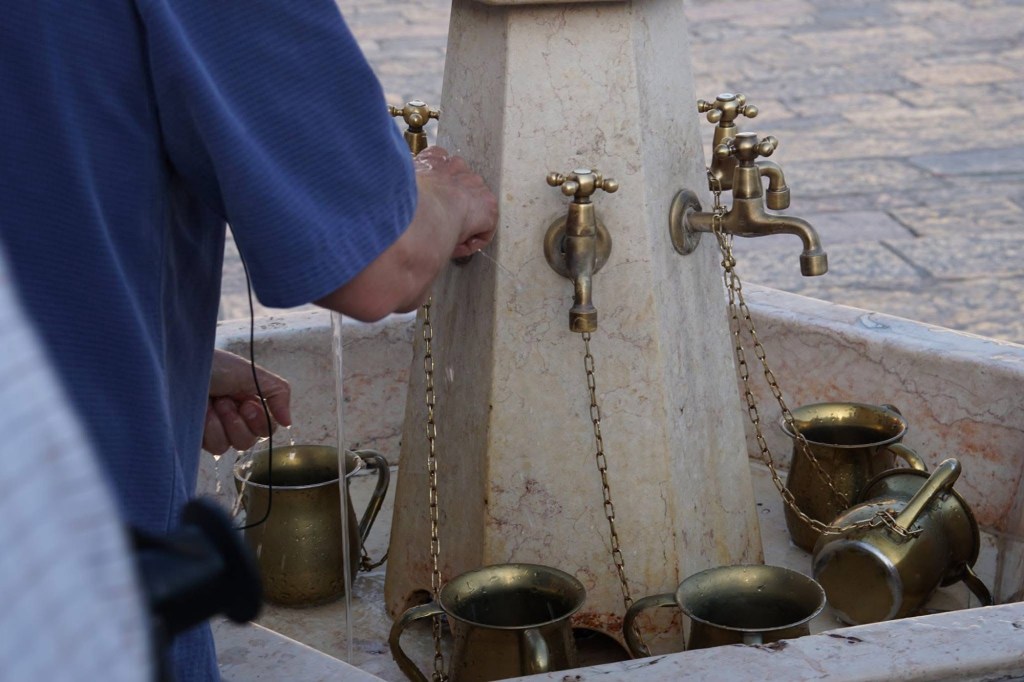
On our trip to Israel years ago, when we visited the Prayer Wall at the old Temple we saw men washing their hands as described.
John Gill
1 Timothy 2:8
I will therefore that men pray everywhere,…. In this declaration of the apostle’s will concerning prayer, he only takes notice of “men”; not but that it is both the duty and privilege of women, as well as men, to pray in their houses and closets; but because he is speaking of public prayer in the church, which only belongs to men, he speaks only of them; and his will is, that prayer should be performed by them everywhere, or in any place, in any part of the world where they lived. Now was the prophecy in Mal 1:11 fulfilled, and now was the time come our Lord refers to, Jhn 4:21. This seems to be said in opposition to a Jewish notion, that the temple at Jerusalem was the only place for prayer, and that prayer made elsewhere ought to be directed towards that. The Jews say (b), that
“there is no way for the prayer of the nations of the world to ascend, seeing the gates of heaven are only opened in the land of Israel.–And again, that the prayers without the land have no way to go up before the Lord, but the Israelites send them without the land opposite Jerusalem; and when they come to Jerusalem, from thence they remove and ascend above.–No prayer ascends above from that place in which it is made, till it come to the land of Israel, and from thence to Jerusalem, and from thence to the sanctuary, and then it ascends above.”
They have also many rules concerning places of private prayer, as that care should be taken that it be not in a place where there is any filth; or any bad scent (c).
Lifting up holy hands; lifting up of hands was a prayer gesture among the Heathens (d), and so it was among the Jews (e). R. Simeon lift up his hands in prayer to the blessed God, and prayed his prayer. Yea, they (f) say,
“it is forbidden a man to lift up his hands above, except in prayer, and in blessings to his Lord, and supplications, as it is said, Gen 14:22 which is interpreted of lifting up of hands in prayer.”
And this was an emblem of the elevation of the heart in prayer to God, without which the former would be of little avail. It is an observation of the Jews (g), we have found prayer without lifting up of hands, but we never found lifting up of hands without prayer. And these hands must be holy and pure; there must be purity of heart, and cleanness of hands, or a freedom from any governing sin, which renders prayer unacceptable unto God; see Isa 1:15. The apostle alludes to a custom of the Jews, who always used to wash their hands before prayer;
“Then Holofernes commanded his guard that they should not stay her: thus she abode in the camp three days, and went out in the night into the valley of Bethulia, and washed herself in a fountain of water by the camp. And when she came out, she besought the Lord God of Israel to direct her way to the raising up of the children of her people.” (Judith 12:7,8)
So it is said (h) of the Septuagint interpreters, that after the Jewish manner they washed their hands and prayed. The account Maimonides gives (i), is this:
“cleanness of hands, how is it done? a man must wash his hands up to the elbow, and after that pray; if a man is on a journey, and the time of prayer is come, and he has no water, if there is between him and water four miles, which are eight thousand cubits, he may go to the place of water, and wash, and after that pray. If there is between him more than that, he may rub his hands, and pray. But if the place of water is behind him, he is not obliged to go back but a mile; but if he has passed from the water more than that, he is not obliged to return, but he rubs his hands and prays; they do not make clean for prayer but the hands only, in the rest of prayers, except the morning prayer; but before the morning prayer a man washes his face, his hands and feet, and after that prays.”
But, alas! what does all this washing signify? Unless, as Philo the Jew (k), expresses it, a man lifts up pure, and, as one may say, virgin hands, to heaven, and so prays.
Without wrath and doubting; or reasoning, or disputation in a contentious way: the former of these, some think, has reference to “murmuring”, as the Ethiopic version renders it, impatience and complaint against God in prayer, and the other to doubt and diffidence about being heard, and having the petitions answered; for prayer ought to be with praise to God, and faith in him: or rather “wrath” may intend an angry and unforgiving temper towards men, with whom prayer is made, which is very unbecoming; see Mat 5:23 and both that and doubting, or disputation, may have regard to those heats and contentions that were between the Jews and Gentiles, which the apostle would have laid aside, and they join together in prayer, and in other parts of public worship, in love and peace. Maimonides (l) says,
“men may not stand praying, either with laughter, or with levity, nor with confabulation, “nor with contention, nor with anger”, but with the words of the law.”
And it is a saving of R. Chanina,
“in a day of “wrath”, a man may not pray (m).”
(b) Shaare Ors, fol. 24. 2, 3. (c) Maimon. Hilchot Tephilla, c. 4. sect. 8, 9. (d) Apuleius de Mundo, p. 276. (e) Zohar in Exod. fol 4. 2. (f) lb. in Numb. fol. 79. 1. (g) T. Hieros. Taaniot, fol. 67. 2. (h) Arist. Hist. 70. p. 98. (i) Hilch. Tephilla, c. 4. sect. 2, 3. (k) De Charitate, p. 698. Vid. ib. de Victim. Offerent. p. 848. (l) Hilch. Tephilla, c. 4. sect. 18. (m) T. Bab. Erubin, fol. 65. 1.
On a more personal note here are my own comments:
Sometimes I repeat the prayer slowly, word for word pausing to reflect upon each word and the richness therein. I don’t do this in the Contemplative/Mystical way, looking for new insights. But just acknowledging words like: “Our” meaning not just my Father, but the one we share as the body of Christ. Or “daily” meaning each day, and there are times I will specifically ask God for a particular concern or request for something that is not actual bread or food related. And “debts and debtors”, yes they are plural. Paul also wrote to Timothy:
1 Timothy 1:15 This is a faithful saying, and worthy of all acceptation, that Christ Jesus came into the world to save sinners; of whom I am chief.
I do have to confess there are nights when I am having trouble falling asleep or going back to sleep that I do go through this reflecting methodically but I don’t think that is biblical. Usually I just count backwards from 100 which often lulls me back into sleep.
Another interesting aspect of prayer it that in my Reformed Bible Study Zoom calls, the pastor leading the study very specifically asks one of the men to close in prayer. I do think this is a practical way to help men exercise this responsibility of leading in Prayer…
Anyway here is Mike’s Post.

 Rainbow Trout