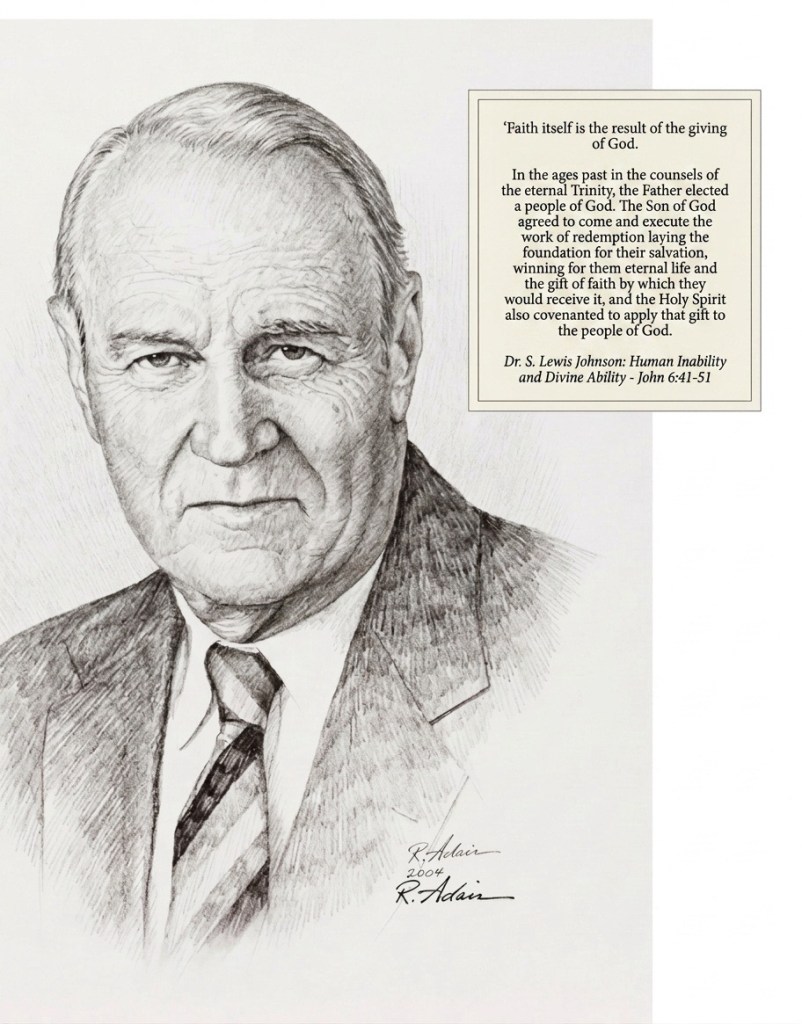
I wanted to close out my research on Dr. Johnson’s Unity in Trinity in the work of our Salvation.

Village of Soglio Hiking in the Swiss Alps – John 6:3 " And Jesus went up into a mountain, and there he sat with his disciples. "
I wanted to close out my research on Dr. Johnson’s Unity in Trinity in the work of our Salvation.


Researching Limited Atonement or Particular Atonement I found these references….
“However, the problem arises when Synergists deny something clearly taught in Holy Scripture, which is that the texts about Christ’s dying for “us” or “his sheep” or his “church” or “the children of God” were intended by God to obtain something more for His people than the benefits they get after they believe. They specifically deny that the death of Christ not only intended by God to obtain benefits for people after they believe, but even more, Christ’s death was intended by God to obtain the very willingness to believe. In other words, the blood of Jesus also obtained the divine grace that it takes to overcome our hardness of heart so that we can become a believer.” Mike Ratcliff.
Yes. One of the clearest places where Dr. S. Lewis Johnson argues that Christ’s death was intended to actually save a particular people—and was not a merely potential salvation for people who never come to faith—is in his series “The Design of the Atonement: For Whom Did Christ Die?”.
In Part IV he states the issue this way:
“Did he die to make the salvation of all men possible and nothing more, or did he die to certainly and actually save through faith his elect people?”
A few paragraphs later he sharpens the contrast:
“My atonement secures the salvation of the elect. Your salvation which you say is intended for all, does nothing more than secure the salvation of the elect… You don’t even get one more person into heaven by your atonement than I do by simply saying… Christ died for the elect.”
Then he summarizes what he sees as the central question:
“Did he die to save those he does save or does he die to save some he doesn’t save as well?”
That statement gets very close to the wording you are remembering. Johnson repeatedly argued that if Christ bore the guilt of a person’s sins in a substitutionary way, then that person must ultimately be saved. Therefore, Christ’s death was not an attempt that fails, nor a payment made for people who finally perish.
Another strong statement from the same sermon is:
“Jesus Christ died, not simply to remove legal obstacles out of the way of all sinners indifferently but to save his people from their sins through faith.”
And in Part VIII he describes the doctrine of particular redemption this way:
“Particular atonement teaching claims that those for whom Christ died are infallibly saved.”
So while I have not yet found the exact phrase “Christ’s death was not wasted on those who never believe,” Johnson’s argument is essentially that very point: Christ died with the intention of actually securing the salvation of His people, not merely making salvation possible for people who may never be saved.
I can also search through the transcripts for places where Johnson uses illustrations such as “double payment,” “God would not punish sins twice,” or where he explicitly says that a universal atonement would mean Christ shed His blood for multitudes who are nevertheless lost forever. Those passages may be even closer to the wording you’re remembering.
LikeLike