I may add some additional data to this post as I think of more perspectives…

As I have been on a ”Sabbatical” from our long time local church here in NoCal since December, over the next two months I need to wind down my observations and perspectives.
Our current local church is now in the EPC, and has been since 2012 when they paid a small fortune to leave the PCUSA, along with a number of other Bay Area Churches.
The church I’ve been attending is Trinity United Reformed Church. It’s about a 30-35 minute drive from our house which is about what I drive to play cheap golf in Walnut Creek, Castro Valley or Concord. The drive time to either the morning service or for a round of golf is a great time to listen to the evening service, so I don’t drive back a 2nd time. I listen to only the sermon, although the whole service is online at Facebook.
I was musing about how small the church is and was surprised to get a really good short description of the difference of these denominations. Trinity in the URCNA group is the smallest. I think the directory has only some 30 or so families, which is the way they count heads. While our EPC church has 300-400 members on the role.
Over time I will characterize lots of differences but for now size is the focus…but you can see some of the basic tenets in this AI generated information also.
Bottom line is the whole URCNA is quite small less than 0.01% of the USA population. The OPC has similar characteristics and is a bit larger. There is an even smaller group:
Communion of Reformed Evangelical Churches CREC
I recently found some good information from one of their churches, but they have some characteristics that don’t seem as correct in my mind. As I’ve read there are up to 47,000 different denominations!
“The Evangelical Presbyterian Church (EPC) is roughly four times larger than the Orthodox Presbyterian Church (OPC) and five times larger than the URCNA, with approximately 125,754 members across 626 churches. [1, 2, 3]
While the OPC and URCNA are often described as “niche” or strictly confessional bodies, the EPC is considered a “medium-sized” or “big tent” denomination that allows for greater diversity on certain theological issues. [1]
Statistical Comparison (Latest Data)
OPC (2025) 33,566
EPC (2025) 125,754
URCNA (approx.) 25,000-30,000
Key Differences from the OPC & URCNA
- The “Big Tent” Approach: Unlike the OPC and URCNA, which require strict adherence to their respective confessions, the EPC operates under the motto: “In Essentials, Unity; In Non-Essentials, Liberty; In All Things, Charity”.
- Women in Office: The EPC allows individual congregations to decide whether to ordain women as deacons or elders (local option), whereas the OPC and URCNA do not permit female ordination.
- Charismatic Influence: The EPC is generally more open to the charismatic movement, whereas the OPC and URCNA maintain traditional, cessationist Reformed worship styles.
- Demographic Trends: While the EPC grew rapidly between 2005 and 2014—largely by absorbing conservative churches leaving the mainline PC(USA)—its membership has recently flattened or seen slight declines, whereas the OPC has seen consistent, albeit very slow, growth.”
Just for comparison, the PCA, which was the 2nd group of Presbyterian Church’s to see and depart the original denomination as they became more liberal, has 400,000 members. Roughly 3 times the EPC.
Those departures were progressive, beginning with the OPC.
“The Orthodox Presbyterian Church (OPC), Presbyterian Church in America (PCA), Evangelical Presbyterian Church (EPC), and ECO each broke away from mainline Presbyterian bodies during different periods of theological tension.
OPC (1936): Formed when J. Gresham Machen and other conservatives left the northern mainline body, the Presbyterian Church in the U.S.A. (PCUSA), during the Fundamentalist-Modernist Controversy.
PCA (1973): Established when conservative congregations separated from the southern mainline body, the Presbyterian Church in the United States (PCUS), over concerns about theological liberalism and the authority of Scripture.
EPC (1981): Created by leaders from both northern and southern branches of mainline Presbyterianism who were distressed by a “continuous theological drift” and institutional resistance to change.
ECO (2012): Formed by congregations leaving the Presbyterian Church (USA) following long-standing debates over theology and the ordination of LGBTQ+ individuals.”
Our local church being a mixed congregation (we have been there now 40 years) departed during that latest round but chose the EPC over the newer ECO.
“While 1936 is the official founding date of the OPC, the movement evolved through several critical stages during the Fundamentalist-Modernist Controversy:
- 1923: The Intellectual Break. With the publication of Christianity and Liberalism, Machen argued that historic Christianity and theological liberalism were two entirely different religions.
- 1929: The Educational Break. When the northern mainline church (PCUSA) reorganized Princeton Theological Seminary to include more “moderate” and liberal viewpoints on its board, Machen and several faculty members resigned. That same year, they founded Westminster Theological Seminaryin Philadelphia to carry on the “Old Princeton” tradition of Reformed orthodoxy.
- 1933: The Missional Break. Frustrated that the official PCUSA mission board was sending out missionaries who denied core doctrines (such as the virgin birth), Machen helped establish the Independent Board for Presbyterian Foreign Missions.
- 1935–1936: The Official Break. The PCUSA ruled that the Independent Board was unconstitutional and ordered its members to resign. When they refused, Machen and others were put on trial and defrocked (suspended from the ministry).
- June 11, 1936: Machen and his followers officially formed the Presbyterian Church of America(renamed the Orthodox Presbyterian Church in 1939 due to a lawsuit from the mainline body)”
So in concept this all began over 100 years ago.
One reads about the two Great Awakenings, and the First Great Awakening and George Whitefield’s and the Wesley’s influence back in the mid 1700’s, up through the founding of our nation 250 years ago, is featured in a recent movie we saw in the theater. But the Downgrade in denominations actually was running strong after another 100 years, and 35 years before Machen.
“The Downgrade Controversy took place from 1887 to 1888. It began in March 1887 when Charles Spurgeonpublished a series of articles in his monthly magazine, The Sword and the Trowel, warning that the Baptist Union was slipping down a dangerous theological “slope”. [1, 2, 3]
The connection between Charles Spurgeon’s Downgrade Controversy and J. Gresham Machen’s 1920s-1930s battle is profound. Historically, Machen’s struggle is viewed as the American Presbyterian sequel to Spurgeon’s British Baptist crisis.
The two controversies share direct institutional, theological, and strategic parallels:
1. The Core Enemy: Theological Liberalism
- Spurgeon’s Battle (1887): Spurgeon soundly attacked the infiltration of German higher criticism, Darwinism, and modernism into the British Baptist Union. He warned that pastors were denying the inerrancy of Scripture, substitutionary atonement, and the reality of hell.
- Machen’s Battle (1923–1936): Machen fought the exact same ideas imported to the United States. In Christianity and Liberalism (1923), Machen argued—just as Spurgeon had—that modern liberalism was not a variant of Christianity, but an entirely different religion altogether.
2. The Failure of “Broad” Denominational Coalitions
- Spurgeon: The Baptist Union tried to preserve institutional peace by refusing to adopt a strict evangelical statement of faith, hoping the debate would simply blow over. Because the Union tolerated vital errors, Spurgeon resigned in October 1887.
- Machen: Machen initially tried to reform the Northern Presbyterian Church (PCUSA) from within. However, the denomination chose institutional unity over doctrinal purity, eventually putting Machen on trial and forcing him out in 1936.
3. The Strategy of Separation
Both men concluded that when a church body refuses to discipline false teaching, faithful Christians must separate:
- Spurgeon’s view: “Fellowship with known and vital error is participation in sin.”
- Machen’s view: Machen actualized Spurgeon’s logic by building new, uncorrupted institutions from scratch, creating Westminster Theological Seminary (1929) and the OPC (1936).
4. Personal Cost and Vindication
Both controversies exacted a massive toll on the health of the two men. Spurgeon faced severe depression and a physical breakdown, passing away in 1892 at age 57. Machen faced exhausting ecclesiastical trials and died in 1937 at age 55. In both cases, history vindicated their warnings: the denominations they left behind continued their rapid theological “downgrade” throughout the 20th century.”
I need to close this train of thought out for this morning at least….If you look at overall numbers the Baptist world is much bigger than the Presbyterian or Reformed world. Even today the numbers show highly influenced by Baptists.
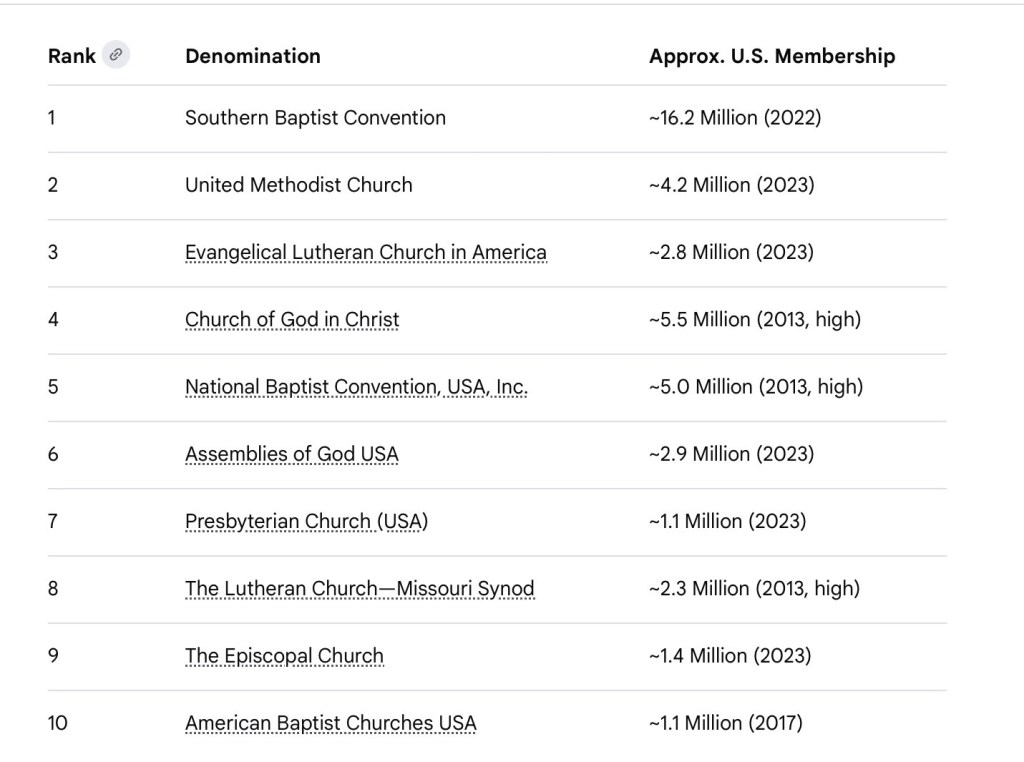
“
The addition of the Roman Catholic Church dramatically shifts the list, as it is the largest single Christian denomination in the United States, encompassing roughly 20% to 22% of the total U.S. population.
When combining the various jurisdictions of Eastern and Oriental Orthodoxy (such as the Greek, Russian/OCA, Antiochian, and Serbian archdioceses), Orthodox Christianity collectively commands about 1% of the U.S. population. Broad sociological polling estimates total Orthodox adherence around 2.5 to 3 million people, though strict active-parishioner counts submitted by the jurisdictions themselves reflect about 700,000 to 1 million active adherents.
1 Roman Catholic Church~65 to 70 Million (Stabilized with a recent 2026 convert surge)
2 Southern Baptist Convention~16.2 Million (2022 dataset; currently experiencing gradual decline)”
One final thing, if you been observant you can see a number of very prominent Roman Catholics in today’s USA political, media and even entertainment world. When JFK was elected, that was the time in England Dr. Martyn Lloyd-Jones was preaching, he has some interesting perspective on the Roman Catholic Church, not well understood today. But JFK was the first RCC President, Joe Biden was recently our second. There are note figures in both political parties, including recent converts to RCC as J. D. Vance, our VP, Marco Rubio, Secretary of State, many today and in the Biden era…
Top National Leaders
- Joe Biden: Served as the 46th U.S. President (2021–2025) and Vice President (2009–2017). He is only the second Roman Catholic president in U.S. history after John F. Kennedy and frequently references his Catholic faith and Catholic social teaching in public life.
- Nancy Pelosi: Served as the Speaker of the U.S. House of Representatives (2007–2011, 2019–2023). She was the first female Speaker and remains one of the most powerful legislative strategists in modern political history, frequently identifying as a devout, lifelong Catholic.
- Tim Kaine: U.S. Senator from Virginia since 2013 and the 2016 Democratic Vice Presidential nominee. He frequently discusses his formative experience as a Catholic missionary in Honduras with the Jesuits.
Current and Recent Governors
- Gavin Newsom: Governor of California since 2019 and former Lieutenant Governor. He leads the nation’s most populous state and was raised in a prominent San Francisco Catholic family.
- Gretchen Whitmer: Governor of Michigan since 2019 and a highly influential figure in the national Democratic Party.
- Tim Walz: Governor of Minnesota since 2019 and the 2024 Democratic Vice Presidential nominee.
- Andrew Cuomo: Governor of New York (2011–2021). He wielded massive regional power during the COVID-19 pandemic and routinely clashed with church leadership over social legislation.
Congressional and Judicial Leaders
- Dick Durbin: U.S. Senate Democratic Whip since 2005 (the second-highest-ranking Democrat in the Senate) and Chairman of the powerful Senate Judiciary Committee.
- Alexandria Ocasio-Cortez: U.S. Representative from New York since 2019. A prominent leader of the progressive wing of the party, she has written publicly about how her Catholic faith shapes her views on criminal justice and environmental policies.
- Sonia Sotomayor: Associate Justice of the U.S. Supreme Court since 2009. Appointed by Barack Obama, she is the first Latina justice and was raised in a traditional Catholic household in New York.
Below are two charts that put this in perspective…BTW, I’ve come a fair way from my opening discussion about small reformed denominations…
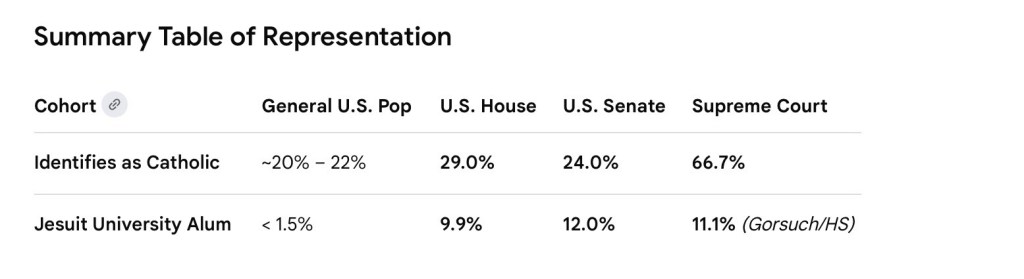
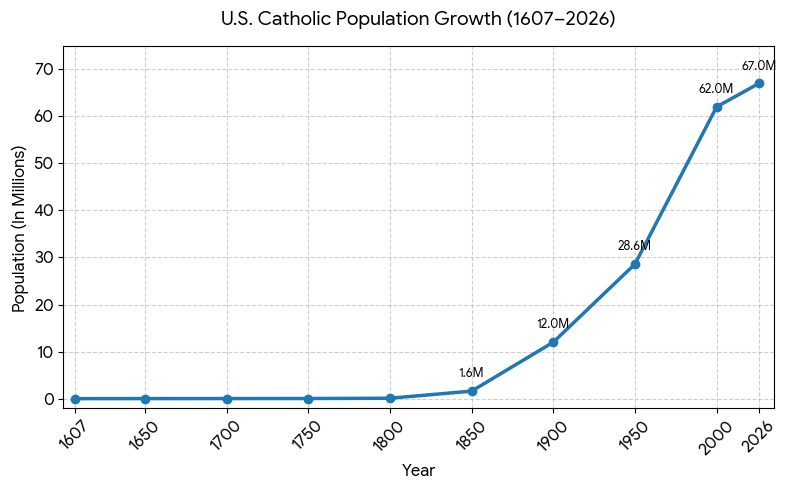
It is interesting, and this will be controversial, to read the old Westminster Confession of Faith….from almost 400 years ago…the important point here is that there is a “Visible” and an “Invisible” Church. Most people, even professing Christian’s don’t know this.
CHAPTER 25
Of the Church
1. The catholic or universal church, which is invisible, consists of the whole number of the elect, that have been, are, or shall be gathered into one, under Christ the Head thereof; and is the spouse, the body, the fullness of him that filleth all in all.
2. The visible church, which is also catholic or universal under the gospel (not confined to one nation, as before under the law), consists of all those throughout the world that profess the true religion; and of their children: and is the kingdom of the Lord Jesus Christ, the house and family of God, out of which there is no ordinary possibility of salvation.
3. Unto this catholic visible church Christ hath given the ministry, oracles, and ordinances of God, for the gathering and perfecting of the saints, in this life, to the end of the world: and doth, by his own presence and Spirit, according to his promise, make them effectual thereunto.
4. This catholic church hath been sometimes more, sometimes less visible. And particular churches, which are members thereof, are more or less pure, according as the doctrine of the gospel is taught and embraced, ordinances administered, and public worship performed more or less purely in them.
5. The purest churches under heaven are subject both to mixture and error; and some have so degenerated, as to become no churches of Christ, but synagogues of Satan. Nevertheless, there shall be always a church on earth, to worship God according to his will.
6. There is no other head of the church but the Lord Jesus Christ. Nor can the pope of Rome, in any sense, be head thereof.
If one wants to spend the time reading a very good history on this I recommend:
“Dr. James Aitken Wylie’s massive, three-volume work, The History of Protestantism, was originally published in serial parts between 1874 and 1877, before being issued as a complete three-volume set by Cassell, Petter & Galpin in 1878. [1, 2, 3, 4, 5]
Free PDF copies of the original work can be downloaded from several historical repositories: [1]
- Volume 1 (Books 1–9): Covers the dawn of the Reformation, early witnesses like the Waldenses, John Wycliffe, John Huss, and the early German Reformation up to the Diet of Worms.
- Download the text-based version from the Northwestern Theological Seminary Library.
- Download an illustrated scan of the original 19th-century publishing directly from the Internet Archive.
- Volume 2 (Books 10–17): Details the consolidation of the German Reformation, the rise of Protestantism in Switzerland, Sweden, Denmark, and France, as well as the founding of the Jesuit order.
- Download a scanned copy of the original printed text at the Internet Archive.
- Volume 3 (Books 18–24): Examines the history of the Reformation in the Netherlands, Poland, Bohemia, Hungary, the 30 Years’ War, and the ultimate progress of Protestantism in England.
- Download the text-based version from the Northwestern Theological Seminary Library.
- Download an illustrated scan of the original 19th-century publishing at the Internet Archive. [1, 2, 3]
If you prefer broken-down formats, individual book chapters (Books 1 through 24) are hosted as separate PDF links on Monergism.
I’ve used various copies of his work. A good one is:
History of Protestantism – Volume 1 – J.A. Wylie (19th Cen)Feb 25, 20112430
History of Protestantism – Volume 2 – J.A. Wylie (19th Cen)Feb 25, 20112549
History of Protestantism – Volume 3 – J.A. Wylie (19th Cen)Feb 25, 20113146
Or the NTS one’s which I mentioned way back in my blog. I think it took Paul, Art and I and later, Dean and Pete about 5 years to read through it aloud in our reading group.
The first mention I made to Wylie on my blog site was twelve years ago. Looking back today this seems unreal.
A Summary Look at the Spiritual Exercises
J. A. Wylie’s summary of the Spiritual Exercises is that it is a clever imitation of what biblically is called conversion. Wylie explains,
“To foster the growth of this infant Hercules [the Jesuit order], Loyola had prepared beforehand his book entitled Spiritual Exercises. This is a body of rules for teaching men how to conduct the work of their ‘conversion.’ It consists of four grand meditations, and the penitent, retiring into solitude, is to occupy absorbingly his mind on each in succession, during the space of the rising and setting of seven suns. It may be fitly styled a journey from the gates of destruction to the gates of Paradise, mapped out in stages so that it might be gone in the short period of four weeks… It combines the self-denial and mortification of the Brahmin with the asceticism of the anchorite, and the ecstasies of the schoolmen. It professes, like the Koran, to be a revelation. ‘The Book of Exercises,’ says a Jesuit, ‘was truly written by the finger of God, and delivered to Ignatius by the Holy Mother of God.’ The Spiritual Exercises …was a body of rules by following which one could effect upon himself that great change which in Biblical and theological language is termed ‘conversion.’…This Divine transformation was at that hour taking place in thousands of instances in the Protestant world. Loyola, like the magicians of old who strove to rival Moses, wrought with his enchantments to produce the same miracle.”
I don’t expect many will agree with the perspective Bennett presents, but perhaps a few will take the time to read it. It does seem to run counter to current thinking from all the major seminaries like Fuller, major demoninations and popular pastors, those who have purpose and mega churches, large video and book congregational pastors, emergent and emerging churches, various forms of Charismatic and seeker friendly Churches…amoung many others. Someone has said we are all catholic now! Just what that means in terms of unity, ecumenicalism, and even syncretism is left to be seen. I have read many good and bad articles on the subject this is just the latest, there is much more to say.
Some might even speculate the Protestant Reformation is over. That would be sad. 😢
Perhaps I’m falsely concerned, and this is all consistent with God’s revelation in the Bible, and I’ve been drawn away from it by my own deception. If so I pray that God would lead me back.


