
Mike Ratliff’s old post on Election is worth reading. And if you take the time to read the comments, you will get a sense of the reaction people have. I’ve written several posts on Election myself. But Mike’s is a great summary..
One of Pastor Ganger’s series goes into this via the Canons of Dort. I recommend these.
http://trinityurcwc.org/?wpfc_sermon_series=canons-of-dordt-2023
http://trinityurcwc.org/?wpfc_sermon_series=canons-of-dordt
http://trinityurcwc.org/?wpfc_sermon_series=canons-of-dordt-2025
http://trinityurcwc.org/?wpfc_sermon_series=canons-of-dordt-2025-2026
As he rotates his evening sermon series around the Three Forms of Unity and The Westminster Shorter Catechism it takes a bit of time to follow through all the sections of the Canon.
When I did a study of these a few years ago, I found them most useful. Here is the link to the URCNA edition:
You can also read the AI summary of some of the terms I’ve posted below Mike’s article.
AI Summary Discussion
The purpose of the Canons of Dort was to answer the theological controversy caused by the followers of Jacobus Arminius and their 1610 “Remonstrance” (protest). The Synod of Dort (1618–1619), an international gathering of Reformed church leaders in the Netherlands, wrote the Canons to defend what they believed was the biblical doctrine of salvation against Arminian teachings on election, grace, free will, and perseverance.
The Canons were not meant to be a complete systematic theology. They specifically addressed the “five points” under dispute. The document explains the Reformed position and rejects what the Synod believed were errors of the Remonstrants.
The five major topics were:
1. Divine election and reprobation
2. Christ’s death and redemption
3. Human corruption and conversion (combined with #4)
4. How grace works in salvation
5. Perseverance of the saints
These later became associated with the “five points of Calvinism” (often summarized as TULIP), though that acronym came much later.
As for the Preface, it served as a historical and theological introduction. It emphasized several things:
– The church had been troubled by doctrinal disputes.
– Christ preserves His church through such controversies.
– The Synod gathered to examine the disputed teachings carefully from Scripture.
– The goal was both to explain the true doctrine and reject false doctrine.
– The work was intended to preserve peace, unity, and purity in the churches.
One famous line from the original preface described the Canons as:
“a judgment, in which both the true view, agreeing with God’s Word, concerning the aforesaid five points of doctrine, is explained, and the false view, disagreeing with God’s Word, is rejected.”
The tone of the Preface is important because it was not written merely as an academic exercise. It presents the Synod as defending the church from teachings they believed endangered:
– assurance of salvation,
– God’s sovereign grace,
– and the glory of God in salvation.
It also stresses that the delegates sought to proceed prayerfully and carefully under Scripture rather than from human speculation.
Today the Canons of Dort remain one of the “Three Forms of Unity” used in many Dutch Reformed churches, alongside the Heidelberg Catechism and the Belgic Confession.
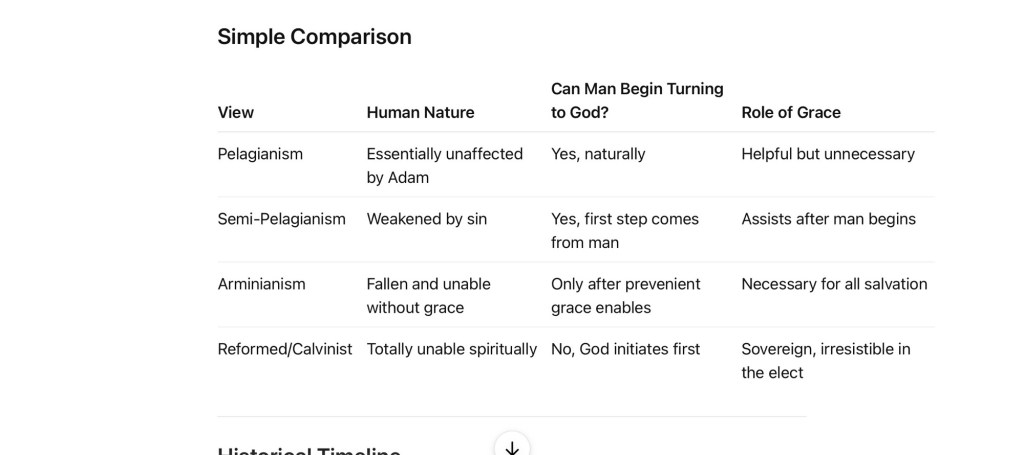
Here is the historical and theological distinction among Pelagianism, Semi-Pelagianism, and Arminianism, along with why “Arminianism” became the common name rather than “Remonstrantism.”
1. Pelagianism
What it taught
Pelagianism taught that man is born morally neutral and has the natural ability to obey God and choose righteousness without the necessity of inward regenerating grace.
Key ideas included:
– Adam’s sin affected only himself.
– Humans are not born spiritually corrupt by original sin.
– Grace helps, but is not necessary for obedience or salvation.
– Man can initiate salvation by free will alone.
Pelagius emphasized moral responsibility so strongly that he minimized man’s fallen condition.
Main figure
Pelagius
Dates
– Active: roughly AD 390–420
– Condemned at:
– the Council of Carthage
– and later the Council of Ephesus
Main opponent
Augustine of Hippo strongly opposed Pelagius, defending:
– original sin,
– inability of fallen man,
– and necessity of sovereign grace.
⸻
2. Semi-Pelagianism
What it taught
Semi-Pelagianism was an attempted middle position between Pelagianism and Augustine.
It admitted:
– original sin weakened man,
– grace is necessary for salvation.
But it taught:
– the first movement toward God comes from human free will,
– then grace cooperates afterward.
In other words:
– Pelagianism: man begins and completes salvation.
– Semi-Pelagianism: man begins, God assists.
– Augustinian/Reformed theology: God begins and completes salvation.
Semi-Pelagianism rejected total inability.
Main figures
No single founder, but associated especially with:
– John Cassian
– monks in southern Gaul (modern France)
Dates
– Developed mainly: AD 420–529
– Formally rejected at the Second Council of Orange
The Council of Orange affirmed:
– necessity of prevenient grace,
– inability apart from grace,
– though it did not go as far as later Calvinism on predestination.
⸻
3. Arminianism
What it taught
Arminianism arose within the Reformed churches and agreed with much of Protestant theology, unlike Pelagianism.
Classical Arminianism taught:
– humans are fallen and corrupted by sin,
– grace is necessary,
– but prevenient grace restores enough freedom for all people to respond,
– election is conditional on foreseen faith,
– Christ died for all equally,
– grace can be resisted,
– true believers may possibly fall away (some early Arminians were uncertain on this point).
Thus Arminianism rejected Pelagianism because it affirmed:
– original sin,
– necessity of grace,
– inability without grace.
But Reformed theologians argued it still made the decisive factor in salvation the human response rather than God’s sovereign election.
Main figure
Jacobus Arminius
Dates
– Arminius lived: 1560–1609
– The Remonstrance of 1610 was issued shortly after his death.
– Answered by the Synod of Dort
⸻
Why is it called “Arminianism” instead of “Remonstrantism”?
The term “Remonstrants” originally referred to the followers of Arminius who submitted the “Remonstrance” (protest/petition) in 1610 to the Dutch government and churches.
So historically:
– “Remonstrants” = the movement/political-ecclesiastical party
– “Arminianism” = the theology associated with Arminius
Over time, “Arminianism” became the broader theological label because:
1. It centered around the teachings of Arminius himself.
2. The theology spread far beyond the Dutch Remonstrant movement.
3. Later groups adopted similar theology without belonging to the historical Remonstrant Brotherhood.
For example:
– many Methodist Church traditions influenced by John Wesley are broadly Arminian,
– but they are not “Remonstrants” historically.
The term “Remonstrant” today usually refers more specifically to the Dutch Remonstrant church tradition that continued after Dort.
A key historical point is that both Roman Catholic and Protestant theologians officially condemned Pelagianism. The major debates later were usually over forms of Semi-Pelagianism and Arminianism, especially concerning how grace and free will interact in conversion.



Canons of Dort Introduction
The Canons of Dort RATIFIED IN THE NATIONAL SYNOD OF THE REFORMED CHURCH Held at Dordrecht in the years 1618 and 1619
The Decision of the Synod of Dort on the Five Main Points of Doctrine in Dispute in the Netherlands is popularly known as the Canons of Dort (or the Five Articles Against the Remonstrants). It consists of statements of doctrine adopted by the great Synod of Dort which met in the city of Dordrecht in 1618–1619. Although this was a national Synod of the Reformed Churches of the Netherlands, it had an international character, since it was composed not only of sixty-two Dutch delegates, but also of twenty-seven foreign delegates representing eight countries.
The Synod of Dort was held in order to settle a serious controversy in the Dutch churches initiated by the rise of Arminianism. Jacob Arminius (1560–1609), a theological professor at Leiden University, departed from the Reformed faith on a number of important points. After Arminius’s death, forty-three of his ministerial followers drafted and presented their heretical views to the States General of the Netherlands on five of these points in the Remonstrance of 1610. In this document and even more explicitly in later writings, the Arminians, who came to be called “Remonstrants,” taught (1) election based on foreseen faith, (2) the universal merits of Christ, (3) the free will of man due to only partial depravity, (4) the resistibility of grace, and (5) the possibility of a lapse from grace. They desired the Reformed church’s doctrinal standards to be revised and their own minority views to be protected by the government. The Arminian-Calvinism conflict became so severe that it led the Netherlands to the brink of civil war. Finally in 1617 the States General voted four to three to call a national Synod to address Arminianism. The Synod held 154 formal sessions over a period of seven months (November 1618 to May 1619). Thirteen Remonstrant theologians, led by Simon Episcopius, used various tactics to delay the work of Synod and to divide the delegates — tactics which proved to be unsuccessful. Under the leadership of Johannes Bogerman, the Remonstrants were dismissed.
The Synod then developed the Canons which thoroughly rejected the Remonstrance of 1610 and scripturally set forth the Reformed doctrine on these debated points, now popularly called “the five points of Calvinism”: unconditional election, limited atonement, total depravity, irresistible grace, and the perseverance of saints. Though these points do not embrace the full scope of Calvinism and are better regarded as Calvinism’s five answers to the five errors of Arminianism, they certainly lie at the heart of the Reformed faith, particularly Reformed soteriology, for they flow out of the principle of absolute divine sovereignty.
They may be summarized as follows: (1) Unconditional election and faith are sovereign gifts of God. (2) While the death of Christ is abundantly sufficient to expiate the sins of the whole world, its saving efficacy is limited to the elect. (3,4) All are so totally depraved and corrupted by sin that they cannot effect any part of their salvation; in sovereign grace God irresistibly calls and regenerates the elect to newness of life. (5) Those thus saved God graciously preserves so that they persevere until the end, even though they may be troubled by many infirmities as they seek to make their calling and election sure. Simply stated, we may say that the subject matter of the Canons is: sovereign grace conceived, sovereign grace merited, sovereign grace needed and applied, and sovereign grace preserved.
Although in form the Canons have only four sections, we speak properly of five points or heads of doctrine because the Canons were structured to correspond to the five articles of the 1610 Remonstrance. The third and fourth sections were purposely combined into one since the Dortian divines considered them inseparable, and hence are designated as “Head of Doctrine 3/4.”
The Canons have a special character because of their original purpose as a judicial decision on the doctrinal points in dispute during the Arminian controversy. The original preface called them a “judgment, in which both the true view, agreeing with God’s Word, concerning the aforesaid five points of doctrine is explained, and the false view, disagreeing with God’s Word, is rejected.”
The Canons also have a limited character in that they do not cover the whole range of doctrine, but focus on the five points of doctrine in dispute. Each of the main heads consists of a positive and a negative part, the former being an exposition of the Reformed doctrine on the subject, the latter a repudiation of corresponding Arminian errors (see shaded parts below). In all, the Canons contain fifty-nine articles of exposition and thirty-four repudiations of error.
The Canons form a remarkably scriptural and balanced document on the specific doctrines expounded. They are unique in being the sole Form of Unity composed by an ecclesiastical assembly and in representing a consensus of all the Reformed churches of their day. Both Dutch and foreign delegates without exception affixed their signatures to the Canons, whether of supralapsarian or infralapsarian persuasion. A service of thanksgiving was held upon the Canons’ completion to acknowledge the Lord for preserving the doctrine of sovereign grace among the Reformed churches.
LikeLike