
Recently returned from a wonderful trip to two Greek Islands. I found Mike’s post this morning worth reading. Enjoy.
Seeds and Soils
I can think of a number of people, even some couples we knew over our years of faith that reflect the conditions of the soil in this parable. And as Mike says it’s still as relevant as ever in today’s world.
Classic examples are Obstinate and Pliable, at the beginning of John Bunyan’s Pilgrim’s Progress. Obstinate never heard the word. And Pliable turned away with these words when quite early the path became difficult.
Pliable..”At this Pliable began to be offended, and angrily said to his fellow, “Is this the happiness you have told me all this while of? If we have such ill speed at our first setting out, what may we expect between this and our journey’s end? May I get out again with my life, you shall possess the brave country alone for me.” And with that, he gave a desperate struggle or two, and got out of the mire on that side of the swamp which was next to his own house: so away he went, and Christian saw him no more.”
The harder reality is those who grow are rooted but choked. This always present. And without the Holy Spirit and the Word of God, we can be easily be led off the path. True believers like Bunyan’s Christian will go this way, but God doesn’t lose them, he finds them and brings them back. Read the whole story.
It is curious to consider, the life of the seed. Having just spent most of a day on the Island of Sifnos in Greece with a wise 70 year old owner of a small farm, I learned a bit about plant intelligence…
Seeds as they develop will know to send out roots into the soil, searching for life giving water, if one waters them shallowly, and close to the stem they don’t mature, likewise if the soil is not worked still as they mature, they can be choked, by not only the weeds and thorns, but the soil itself.
From my own small garden, I know it’s hard labor to work the soil into good condition. But we don’t labor for our own salvation and justification. It is a gift of Grace and a work of the Holy Spirit. Once our hearts are made soft and we are made open to the Gospel, the Spirit continues to help us to mature. In the hills of Sifnos one sees just how rocky the soil is and the number of rocks over the centuries that had to be removed and the walls and terraces they made. There is good rich soil between in the terraces and we walked a number of the hard pathways along side them.
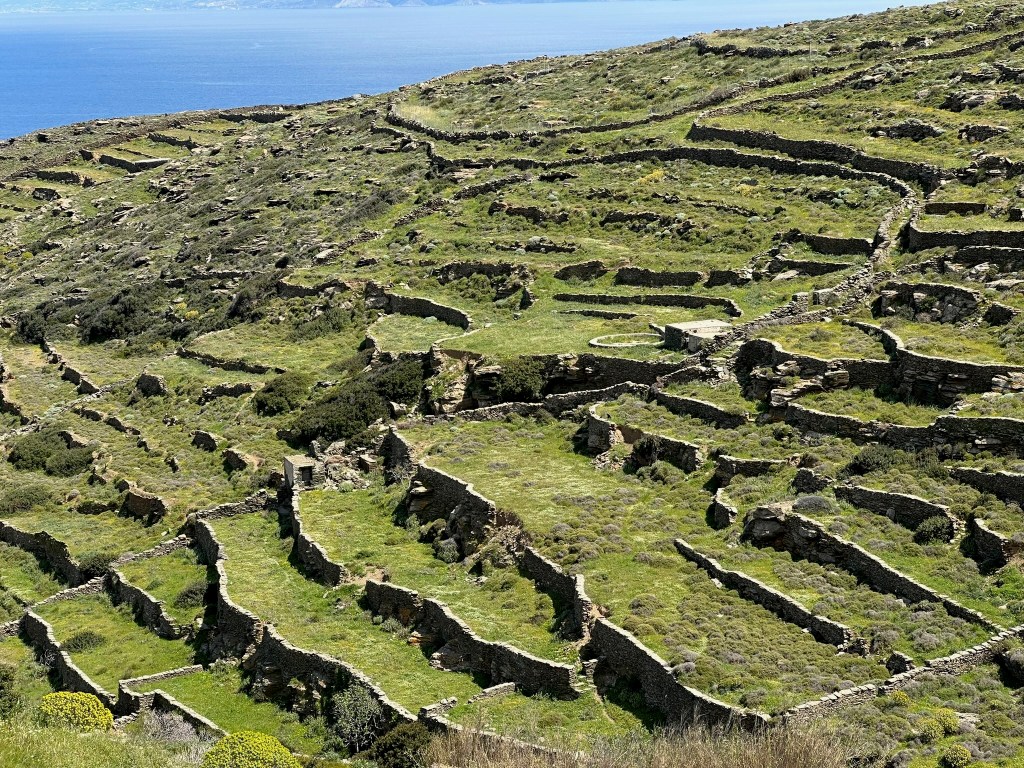
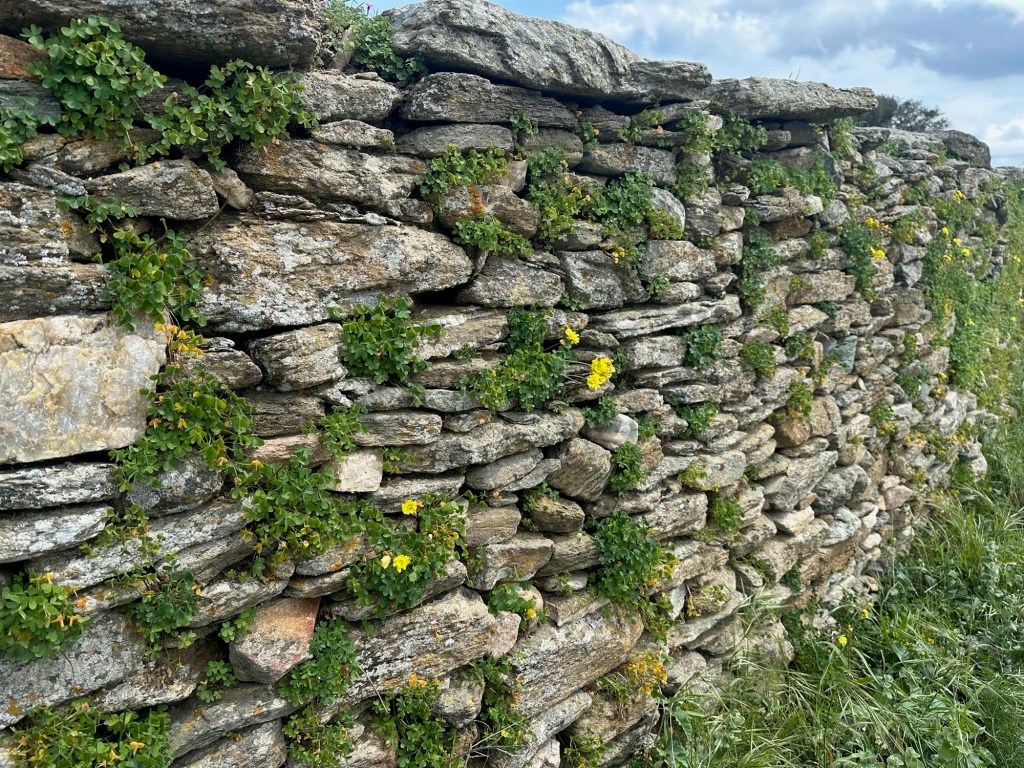
The gospel is presented as the good seed, but the true believer is also often described as a seed such as when we are described as Abraham’s Seed….but not of ourselves. Only by being rooted in Christ. Which ties into the idea of we are not alone but branches in the vine. Even tomato’s are vines as are cucumbers and watermelons, they are plants yet vines, and the branches if you look closely are what bears the fruit.
Gal 3:16 Now to Abraham and his seed were the promises made. He saith not, And to seeds, as of many; but as of one, And to thy seed, which is Christ.
Old John Gill has an interesting comment on this verse.
and to thy seed, which is Christ; meaning not Christ personal, though he was of the seed of Abraham, a son of his, as was promised; but the covenant and the promises were not now made with, and to Christ, as personally considered, this was done in eternity; but Christ mystical, the church, which is the body of Christ, of which he is the head, and is called by his name, 1Co 12:12 and designs all Abraham’s spiritual seed, both Jews and Gentiles; who are all one in Christ, and so Abraham’s seed, and heirs according to the promise; hence there is no room for the objection of the Jew to the apostle’s application of this passage to Christ (c), that the Scripture speaks not of any particular person, but of seed in a general and collective sense, of a large and numerous offspring; since the apostle designs such a seed by Christ, as numerous as the stars of the sky, and the sand on the sea shore, even all believers in all nations, Abraham is the father of; though did the apostle mean Christ particularly, and personally considered, there are instances to be given, where the word “seed” is used, not in a collective sense, but of a single person, as in Gen 4:25.
1 Corinthians 12:12 (KJV)
12 For as the body is one, and hath many members, and all the members of that one body, being many, are one body: so also is Christ.
Genesis 4:25 (KJV)
25 And Adam knew his wife again; and she bare a son, and called his name Seth: For God, said she, hath appointed me another seed instead of Abel, whom Cain slew.
As to the fruit of the vines, and the vines of the church in Christ our host, the farmer, made a statement that struck me as profound. The plants know they are to produce fruit, but they don’t do that for our benefit. They do that for their own survival, the fruit produces their seed, which they pass on to future generations, the plants will die after producing fruit. It was an interesting thought. He said he learned that if the fruit is harvested the plant will say to itself “I have no fruit” and it will go on to product more fruit again to be harvested….in this sense the bounty comes from the harvesting.
I’m not sure I can carry the Biblical analogy much further without speculating. But part of this may explain other examples in Scripture, the pruning to produce fruit again next season, the dunging, to revive the tree.
As for the Harvest, or the fruit itself. It a major sense it’s the producing of the new good seed to be sowed in the lives of the next generation to be call by God through the work of the Holy Spirit and the Word of the Gospel.
Mike’s commentary speaks also about the fruit of the Spirit in our lives. In Character and Behavior.
One sees that as healthy plants, we need to grow deep roots. Those are our knowledge and understand of the Scriptures…..and lead to our outward works.
2Ti 3:14 But continue thou in the things which thou hast learned and hast been assured of, knowing of whom thou hast learned them;
2Ti 3:15 And that from a child thou hast known the holy scriptures, which are able to make thee wise unto salvation through faith which is in Christ Jesus.
2Ti 3:16 All scripture is given by inspiration of God, and is profitable for doctrine, for reproof, for correction, for instruction in righteousness:
2Ti 3:17 That the man of God may be perfect, throughly furnished unto all good works.
And as for good works….as I mentioned earlier they don’t earn us anything. But are reflections of the Grace of God in our lives. And not for our glory but his glory…
WCF CHAPTER 16 Of Good Works
- Good works are only such as God hath commanded in his holy Word, and not such as, without the warrant thereof, are devised by men, out of blind zeal, or upon any pretense of good intention.
- These good works, done in obedience to God’s commandments, are the fruits and evidences of a true and lively faith: and by them believers manifest their thankfulness, strengthen their assurance, edify their brethren, adorn the profession of the gospel, stop the mouths of the adversaries, and glorify God, whose workmanship they are, created in Christ Jesus thereunto, that, having their fruit unto holiness, they may have the end, eternal life.
- Their ability to do good works is not at all of themselves, but wholly from the Spirit of Christ. And that they may be enabled thereunto, beside the graces they have already received, there is required an actual influence of the same Holy Spirit, to work in them to will, and to do, of his good pleasure: yet are they not hereupon to grow negligent, as if they were not bound to perform any duty unless upon a special motion of the Spirit; but they ought to be diligent in stirring up the grace of God that is in them.
- They who, in their obedience, attain to the greatest height which is possible in this life, are so far from being able to supererogate, and to do more than God requires, as that they fall short of much which in duty they are bound to do.
- We cannot by our best works merit pardon of sin, or eternal life at the hand of God, by reason of the great disproportion that is between them and the glory to come; and the infinite distance that is between us and God, whom, by them, we can neither profit, nor satisfy for the debt of our former sins, but when we have done all we can, we have done but our duty, and are unprofitable servants: and because, as they are good, they proceed from his Spirit; and as they are wrought by us, they are defiled, and mixed with so much weakness and imperfection, that they cannot endure the severity of God’s judgment.
- Notwithstanding, the persons of believers being accepted through Christ, their good works also are accepted in him; not as though they were in this life wholly unblamable and unreprovable in God’s sight; but that he, looking upon them in his Son, is pleased to accept and reward that which is sincere, although accompanied with many weaknesses and imperfections.
- Works done by unregenerate men, although for the matter of them they may be things which God commands; and of good use both to themselves and others: yet, because they proceed not from an heart purified by faith; nor are done in a right manner, according to the Word; nor to a right end, the glory of God, they are therefore sinful, and cannot please God, or make a man meet to receive grace from God: and yet, their neglect of them is more sinful and displeasing unto God.


I appreciate how this reminds us that growth really takes time, depth and care, both spiritually and practically.
LikeLike